



Lately, I have been wrestling with deep feelings of insecurity.
When I encounter these moments, I find myself looking for signs, seeking counsel, and desperately trying to figure out what is going to happen. It is as if I believe the answer I desire is going to be found out there and I temporarily forget that the true answers are inside myself.
Every time I write something, make a post, or look in the mirror—all I can see are my imperfections; the wiry gray hairs sprouting from my center part, my less-than-perfectly flat stomach no matter how many crunches I do, and the lines collecting around the corners of my eyes that no makeup or filter can conceal. All that seems to come into focus are the places where I can try harder, do better, or become more.
It feels like someone hit the negative self-talk loop button in my brain—and I can’t find the off switch.
I am not quite sure where this all came from—maybe it was a combination of being out of my normal routine and taking a break from school, leaving me with more time to think. I am also at a point in my relationship where things have gotten real…like, really real. One year in, the honeymoon high has abated (albeit not entirely), and we are left with two imperfect humans struggling to make their dreams come true in a perfectly flawed world.
But a change in routine and deepening attachment shouldn’t catalyze an existential crisis, right?
However, the truth is—it feels like there is a lot to lose right now.
I am afraid I will never make it as an artist and writer.
I am afraid I will fail at another relationship.
I am afraid that I will never become a mother.
Insecurity is the canary in the coal mine of my own fear.
The real danger is that fear and insecurity become a self-fulfilling prophecy; and God knows I have been down that road before.
The way I see it, insecurity stems from a sense of disconnection from self.
It often begins with a rupture inside one’s own body. An image, a passing comment, or an emotional dream can trigger a psychosomatic domino effect that pulls us out of the present moment.
Next, the sense of disconnect seeps into a spiral of self-deprecating and catastrophizing thoughts that slowly ripple outward—into our perceptions, behaviors, and eventually, into our most precious relationships.
Before we know what is happening, our brain has been hijacked by fear and we are scrolling through our partner’s Instagram feed comparing ourselves to strangers, wondering, “did they like it?”.
Insecurity is often experienced as a feeling of anxiety, despair, isolation, or a gnawing fear that something we love is going to be taken away. Insecurity is a tightness that lives in the jaw, a clenching sensation that dwells in the pit of your stomach and a numbness that moves through the body in a wave of shame and fear.
When I think back to my earliest experiences of insecurity, I remember going to parties with my high school girlfriends who I thought were prettier than me. I don’t know if they were objectively more beautiful or not, we were all cute, slim, blonde-haired teenage girls, but they were certainly better at presenting with a more conventional standard of beauty. I felt jealous of the attention they received, and insecure about my own looks. From my early teen years I rebelled strongly against beauty culture. I refused to wear makeup. I dreaded my hair and dressed in clothes that I could hide in; baggy carpenter pants and oversized hoodies. This presentation created a conflicting juxtaposition in my consciousness—deep down, I wanted to be pretty, and I knew I was, but I didn’t want to be seen.
As an adult, the script has shifted to envy of women who are mothers; who have long-term, happy marriages with men who commit to them; and who have success with their creativity or careers. While I find so much satisfaction and spiritual fulfillment in the winding path I have walked—part of me still yearns for the normalcy of a white-picket fence life. Whenever I run into a friend with their kid in the grocery store, I find myself feeling confronted and painfully aware of what I am lacking.
When I was a teen, I remember feeling ashamed, jealous, and shut-down in social situations—like I couldn’t quite figure out where and how I fit in. So I would just get high or drunk and invariably find myself in a mildly threatening situation with an older guy. My memory of that time is littered with dissociated, frozen screen-captures of sexual moments that I could have certainly lived without. Escaping my body had become the default way for me to find some experience of comfort within it—but even hiding and escaping became dangerous, eventually.
It turns out, a too-high girl in an oversized hoodie looking insecure in the corner is a more obvious target than a hot girl, surrounded by her friends.
Years later, when my repressed memories of early sexual abuse came to light for resolution, this part of the story started to make more sense. I learned early to associate love, sex and relationships with trauma—and that story followed me for a very, very long time. Throughout my teens, twenties, and even well into my thirties I continued to find myself swimming in experiences of devastating heartbreak, loss, and instability.
Relationship after relationship ended in traumatic cataclysm—punctuated by betrayal, infidelity, and financial loss.
It was as if I had no solid ground beneath me to stand on… all I knew was the quicksand of insecurity.
While security tells us that we are safe, nourished, protected and provided for—insecurity tells us that we are exposed, alone and we don’t belong. It is an alarm blaring inside our brains, “You are not safe! Take cover! It is every man for themselves!”. Living with insecurity requires us to create a thick shield of self-protection under the guise of safety—but really, we are safeguarding ourselves from intimacy with the people closest to us.
The greatest eco-psychological thinkers of our time theorize that this feeling stems from our original trauma: the moment when we were harshly, and forcibly, removed from the womb-like matrix of the Earth itself. Whether through a shifting climate, cosmic catastrophe, migration or colonization—there was a moment in all of our ancestral histories when we had to reluctantly leave our native homelands and inherited sense of belonging.
This rupture still dwells within the collective psyche, quietly shaping our sense of safety and self-worth—and fueling a form of insecurity that has become pervasive and profoundly marketable.
If you have ever stood in front of the mirror and criticized your own body, piece by piece, this is a physical experience of our disconnection from the Earth. We have learned to hate, control, and make an object of that which gives us life.
Let’s be honest, in this world of unattainable beauty standards, filters, and AI—keeping our feet on the ground and our confidence high takes some serious self-worth. I am putting myself out there to be seen more than ever, through this Substack publication, my podcast and social media. And trying to articulate the self to the world through words, images and catchy sound bites is inherently fragmenting. So maybe this is just some sort of vulnerability contraction? Could be.
Perhaps, the question I need to answer is not, “How do I become more secure?”, but is actually, “How do I become even more connected to myself?”
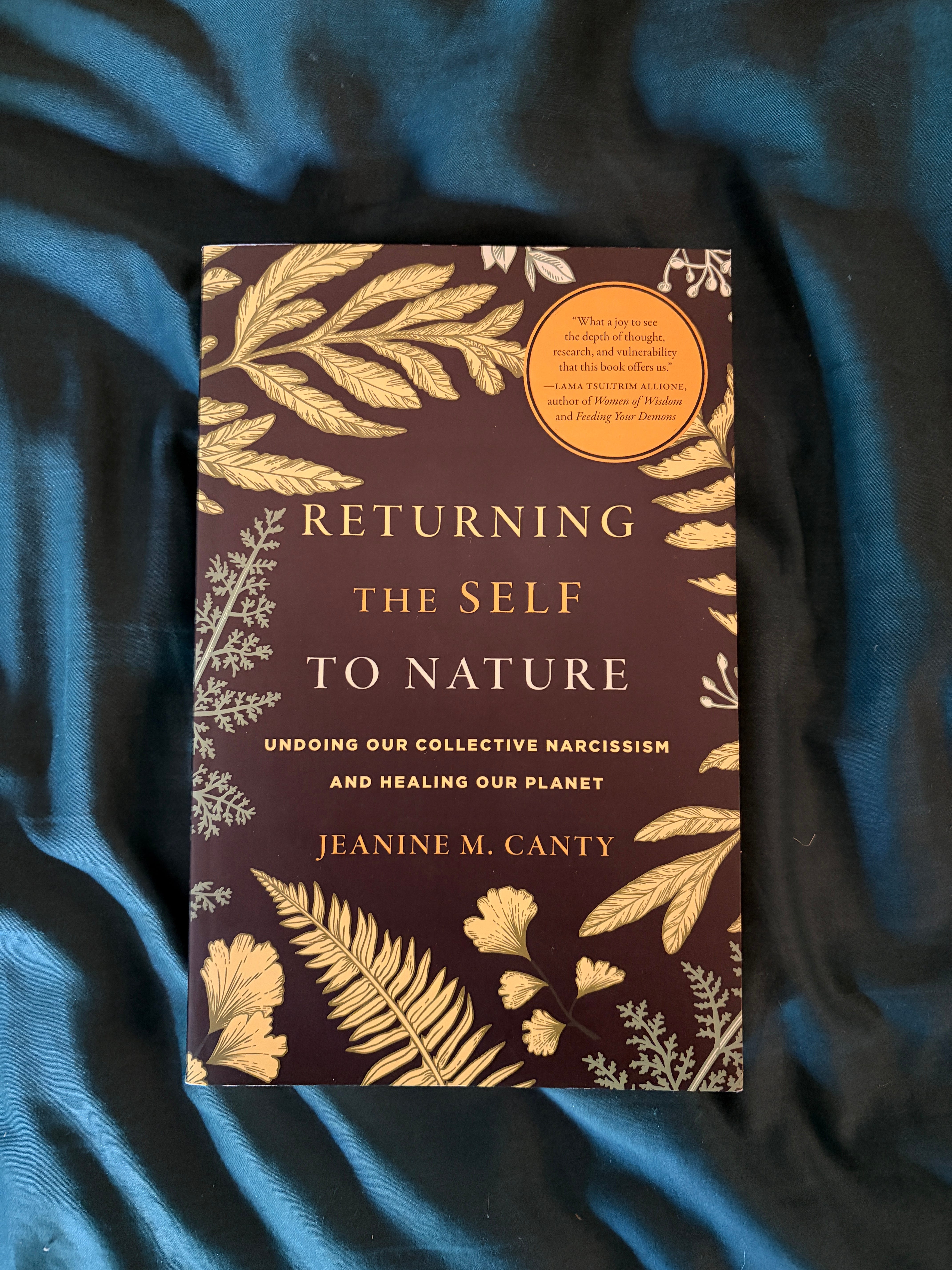
I recently finished reading Jeanine M. Canty’s brilliant 2022 book, Returning the Self to Nature. I sat down with this book thinking I would just skim through it for a couple hours in the afternoon—but I found myself curled up on the couch devouring every word, scrawling quotes in my notebooks and highlighting paragraphs, until it was finished.
This piece of writing evoked something in me. I felt seen by it. I felt understood. I felt as though my own stories, ideas, and words suddenly made sense and were contextualized within a lineage of women-thinkers and writers. Women who had also struggled to belong, until they gave up trying….and then they wrote about it.
Without turning this essay into a confessional, I will say that I am yet again at a crossroads. Or at least, an experience that can be perceived as one. I have found over time that even when we are presented with multiple options, at the end of the day, there is only one real answer. In time, the rest will simply fall away and the truth will reveal itself.
Free will is revealing itself to be an illusion, to some extent. My friend Nala (a genius Vedic astrologer) recently told me that in the Vedic perspective, free will is like a cow tied to a wooden pole. It can do whatever it wants around the pole—but that’s as far as it can go. This idea is a somewhat nihilistic perspective on free will, but the deeper I journey into life, the more it resonates. If we really had free will, wouldn’t we all liberate ourselves from the patterns that we suffer from the most? It seems as though no matter how much self-work we do, some of these patterns continue to repeat themselves—and we just get better at dealing with them.
Just as we are born a certain height, with a specific eye color, and into our family of origin—there are some things that we simply cannot change. The more that I accept these unchanging facts and surrender into them, the more I can rest into the uncertainty in my reality.
Some things are not meant to be controlled.
This practice is teaching me that the antidote to insecurity is not confidence—it’s trust.
Trust that fear obscures our ability to see the greater plan. Trust that somehow, some way, things will work out. Trust that there is a greater intelligence moving through our lives—even when we cannot see it clearly.
If I try too hard to figure things out, to come up with solutions or answers, I am missing the opportunity to be fully present with the cosmically orchestrated unfolding.
But you know what? Sometimes it is scary as f*ck to trust the process.
Sometimes, it is scarier to trust than it is to white-knuckle our way through it.
White-knuckling through life is familiar. It gives us a sense of control of the outcome.
When life shows us time and time again that we can get hurt, we can fail—and we will—we start to anticipate pain before it even arrives. Once that process begins, we are in a standoff with life trying to protect ourselves from an imagined painful future.
That doesn’t help either.
This same friend who spoke to me about the cow metaphor said something else that I thought was pretty funny, “for all the good it does to get upset and struggle against what is happening in our lives…we may as well not”.
That is the teaching, isn’t it? To accept life as it is, fully. To not react, to not try and control it, to become a neutral observer in the unfolding of our karma.
That is Buddha-level.
I don’t think I am quite there yet in this lifetime—but I feel like, at the very least, I am beginning to understand the assignment.
What we want and what life gives us will often be at odds. Our ability to accept who we are and what we have been given with gratitude is the only route to inner peace.
I think this is what you would call spiritual maturity.
Nietzsche said, “Never trust a thought you have indoors”; and I resonate with that.
The only thing I know is that in my deepest moments of grief, the one truly productive solution I have found is to walk in the woods, listen to the birds, and remember that even when I am lost—I am still connected to everything.
The forest is where I feel the most beautiful, the most alive, radiant, calm, peaceful and secure.
When I am walking through the woods I reach a point where I can finally exhale—and fully trust the process.
Questions to Consider
How are you staying connected to yourself through so much upheaval, confusion and overwhelming information?
What keeps you grounded in moments of uncertainty?
Do you trust the process?
Ready to go deeper?
If the forest of your soul is calling you, let’s walk together.
My 1:1 sessions are rooted in relational ecology; the collective transformative process; and connection to the body, the self, the Earth and the intelligence of life itself.
I support seekers ready to engage their dreams, visions and inner landscapes with curiosity and soul-led intention, particularly those navigating trauma, addiction, thresholds of identity or spiritual awakening.
Love this!! ☀️